A leading company specializing in the supply, installation, and maintenance of fire pumps and fire protection systems in Egypt. We provide integrated, UL/FM certified solutions at the highest quality and competitive prices. For inquiries, contact us now on WhatsApp: +201001633259
Introduction: Why is the Electric Fire Pump the Backbone of Any Fire Suppression System?
When we talk about fire protection systems in any facility—whether a towering residential skyscraper, a massive industrial factory, or a bustling commercial complex—the very first and most critical component that comes to mind is the electric fire pump. It is not just a piece of equipment; it is the beating heart that pumps life into the fire suppression network and the first line of defense upon which the entire system relies during a fire emergency.
In this article, we will dive deep into the details of electric fire pumps, starting from their working principle and types, to their basic components and when they become the optimal choice for your facility. We will also explore why specialized fire fighting lines supply and installation companies are the most crucial link in ensuring the system's success.
Part One: What is an Electric Fire Pump?
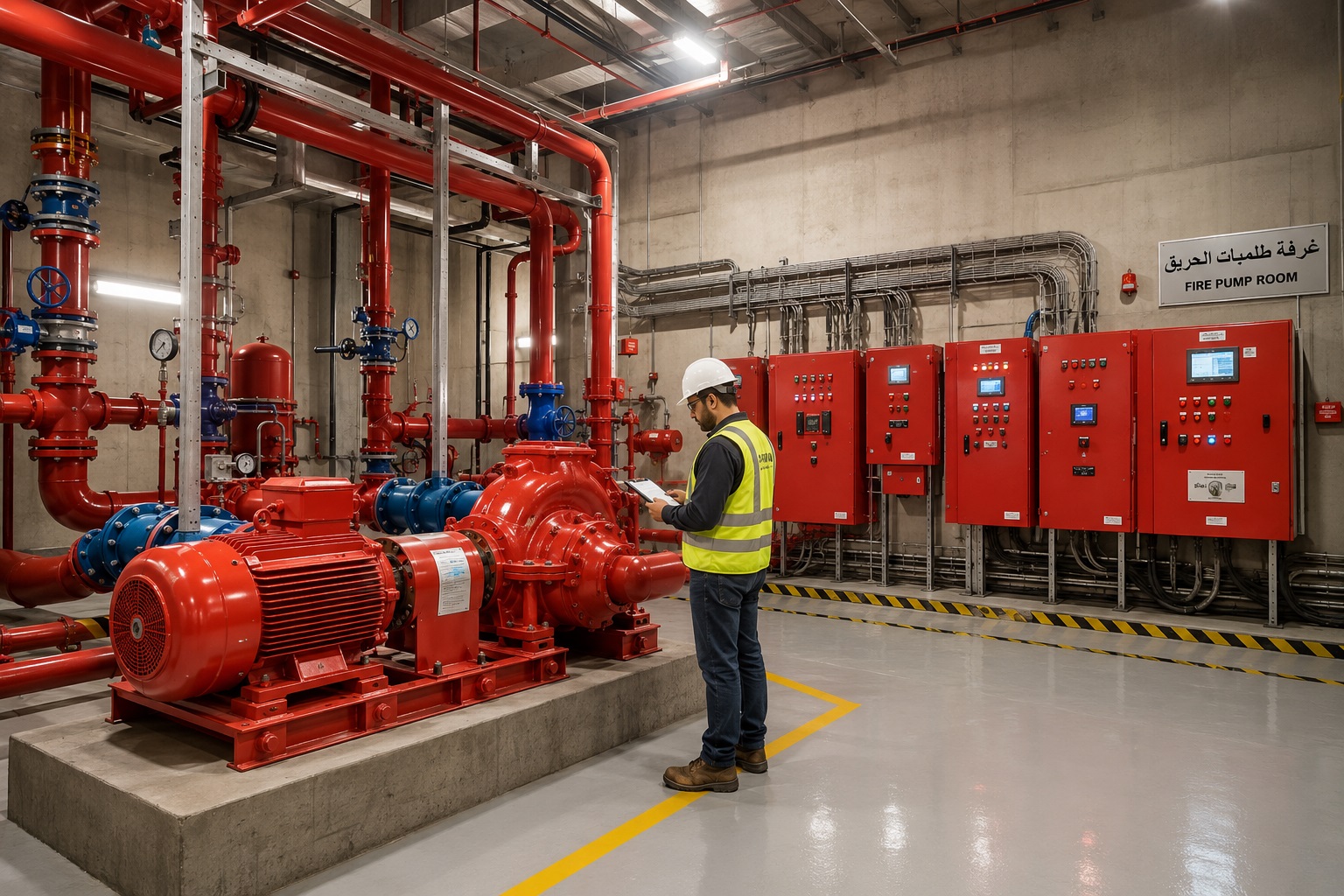
An electric fire pump is a centrifugal pump driven by an electric motor, used to boost water pressure and supply the fire suppression network with the required flow to extinguish fires. This pump is considered the main duty pump in most engineering designs, as it is relied upon to provide the system's hydraulic requirements under normal network operating conditions.
These pumps are characterized by their ability to deliver high pressures and large flows proportionate to the facility's size and type. They are designed to operate for extended periods without interruption, making them the top choice for engineers and contractors when designing fire protection systems.
Part Two: Types of Electric Fire Pumps by Mechanical Design
Electric fire pumps are available in two primary mechanical designs, each with its own uses and advantages that make it suitable for specific types of projects. This diversity necessitates dealing with experienced fire fighting lines installation companies to determine the right type for your project.
1. End Suction Pumps
This design is the most common in small and medium-sized projects, where water enters from one side (the front) and exits from the top.
Advantages: Simple design, easy maintenance, occupies less space, and is cost-effective compared to other types.
Applications: Residential buildings, small commercial complexes, and projects requiring medium flows (up to approximately 1500 gallons per minute).
2. Split Case Pumps (Horizontal Split Case)
This design is the ideal choice for large-scale, massive projects requiring very high flows. In this type, water enters from both sides of the impeller, providing excellent hydraulic balance.
Advantages: Very high hydraulic efficiency, long service life, capability to handle enormous flows (up to over 5000 GPM), and easy maintenance as the upper half of the pump casing can be removed without disconnecting the entire piping system.
Applications: Large factories, power generation plants, mega hotels, and high-rise buildings (skyscrapers).
Part Three: Basic Components of an Electric Fire Pump
To understand how these pumps operate and how to maintain them, it is essential to recognize their basic components that enable efficient operation:
Electric Motor: The power source that drives the pump. The motor's power rating (in kW or HP) must match the pump's flow and pressure requirements. High-quality, thermally insulated motors are used to withstand continuous operation.
Impeller: The rotating part responsible for increasing the water's velocity and pressure. It is manufactured from corrosion-resistant materials such as bronze or special cast iron.
Casing: The outer shell that houses the impeller and water, directing the flow from the suction inlet to the discharge outlet. In Split Case pumps, the casing is divided into two halves for easier maintenance.
Shaft: Transfers the rotational motion from the electric motor to the impeller.
Mechanical Seals: Prevent water leakage from the pump along the shaft, maintaining operational efficiency.
Baseplate: The concrete or steel foundation on which the pump and motor are mounted to ensure alignment and prevent vibrations.
Part Four: Advantages of Electric Fire Pumps
Why do engineers worldwide prefer electric pumps as the primary choice in fire protection systems? Here are the key advantages:
High Operational Efficiency: Electric pumps are highly energy-efficient compared to diesel engines, especially under high operational loads, reducing electrical energy consumption.
Low Operating Costs: Relying on electricity makes daily operating costs significantly lower than running diesel engines that consume fuel and oil.
Lower Maintenance: With fewer moving parts compared to diesel engines, they require less maintenance and lower spare parts costs over the long term.
Quiet Operation: They do not produce excessive noise, making them ideal for residential, administrative buildings, and hotels where silence is required.
Instant Start: As soon as the start signal is received from the control panel or pressure switch, the pump immediately begins pumping water without any delay.
Despite their many advantages, electric pumps are not the best solution under all circumstances. Here are the scenarios where they are the ideal choice:
When a Stable Electrical Grid is Available: If your facility is located in an area with a stable power grid and minimal power outages, the electric pump is the first and best choice.
In Residential and Administrative Projects: Where noise requirements are low and operating costs are a significant factor.
When a Backup Power Source is Available: If the facility is equipped with backup generators to power the pump in case of a power failure, relying on an electric pump is excellent.
In Medium to High-Flow Projects: Where electric pumps, especially the Split Case type, offer exceptional efficiency in handling large flow rates.
Part Six: Periodic Maintenance – The Key to Longevity and Performance Efficiency
Simply installing a high-quality electric fire pump is not enough. You must adhere to a periodic maintenance program to ensure its readiness at any moment. This is why dealing with specialized companies that provide both supply and installation of fire fighting lines and maintenance services is a smart investment. Periodic maintenance includes:
Daily Visual Inspection: Checking for any leaks and monitoring pressure and temperature readings on the control panels.
Regular Oil and Grease Checks: Lubricating bearings and checking oil levels in the motor (if applicable).
Electrical Connection Checks: Verifying cable integrity, insulation strength, and the operation of protection relays.
Weekly Operational Test: Manually running the pump for a short period to ensure it operates correctly and is free from abnormal vibrations or unusual noises.
Alignment Check: Ensuring the motor shaft is properly aligned with the pump shaft using specialized laser alignment tools to prevent vibrations and premature bearing wear.
Part Seven: Why Choose Our Company for the Supply and Installation of Electric Fire Pumps?
We understand that selecting the right equipment and ensuring proper installation are half the battle for safety. Therefore, we offer you in our company:
Certified Products: All our pumps are UL and FM certified and comply with NFPA 20 standards.
Expertise in the Egyptian Market: We have a proven track record of successful projects across various sectors.
An Integrated Technical Team: Comprising highly trained engineers and technicians to ensure professional installation.
After-Sales Services: We offer comprehensive maintenance contracts and genuine spare parts to ensure your facility's continuity.
Competitive Prices: We provide the best value for money without compromising on quality.
Part Five: When is an Electric Pump the Optimal Choice for Your Facility?
We recommended you to subscribe to our newslatter, enter your email below to get daily update about us.

 Arabic